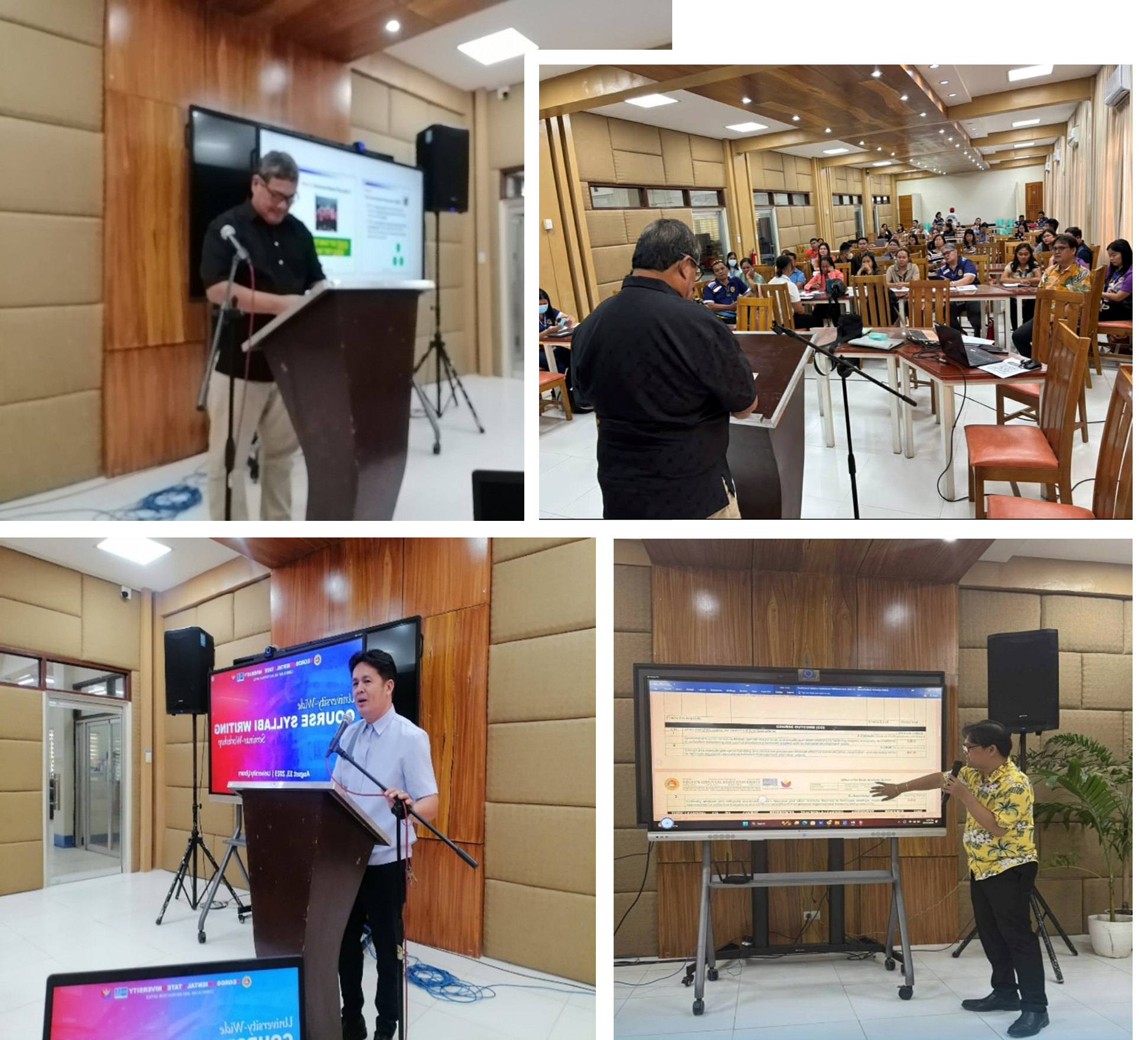







Negros Oriental State University (NORSU) conducted a series of syllabi-writing seminar-workshops across its campuses in August 2025 to harmonize undergraduate programs using the CHED NIR-driven format, bringing together deans, program chairpersons, and senior faculty members by discipline to ensure consistent, outcomes-based course delivery across the university. Held at the NORSU Library Hall from 8:00 a.m. to 5:00 p.m., the workshops were led by Dr. Ralph A. Cardeño, Director for Curriculum and Instruction, who spearheaded the faculty training sessions across clusters, emphasizing the Institutional to Instructional Crafting of an OBE Syllabus. He was joined by Dr. Roulette P. Cordevilla, Assistant Dean of the College of Teacher Education, and Prof. Jade P. Melancio, who specifically assisted in the Teacher Education Cluster. The overall conduct of the trainings was facilitated by Prof. Carlo “Scarlet” M. Gadingan, together with the staff of the Office of Curriculum and Instruction (OCI), ensuring technical guidance, uniform templates, and alignment checks throughout the workshops.
Implemented through discipline-based clustering rather than by campus, the initiative promoted cross-campus collaboration, peer mentoring, and standard-setting. It aimed to transition NORSU into a standardized syllabus format aligned with CHED Policies, Standards, and Guidelines (PSGs), Philippine Qualifications Framework (PQF) Level 6 descriptors, and 21st-century competencies, while strengthening vertical and horizontal alignment among Program Educational Objectives (PEOs), Program Learning Outcomes (PLOs), Program Outcomes (POs), Course Intended Learning Outcomes (CILOs), Teaching-Learning Activities (TLAs), and Assessments.
The workshops opened on August 13, 2025, with the College of Teacher Education, participated in by 50 faculty members from the Main Campus, Mabinay, Siaton, Guihulngan, Bais, and Bayawan–Sta. Catalina campuses. Participants worked on syllabi for Bachelor of Early Childhood Education, Bachelor of Elementary Education, Bachelor of Secondary Education with various majors, Bachelor of Physical Education, and Bachelor of Technology and Livelihood Education.
On August 14, 2025, the College of Industrial Technology convened 34 participants to harmonize syllabi for Bachelor of Industrial Technology majors offered across the Main, Mabinay, Guihulngan, Bais, and Bayawan–Sta. Catalina campuses, as well as Bachelor of Science in Aviation Maintenance (Airframe and Powerplant, Avionics) offered only at Bajumpandan, Main Campus 2.
The College of Arts and Sciences followed on August 15, 2025, with 78 participants working on programs including BS Information Technology, Computer Science, Biology, Chemistry, Geology, Mathematics, Psychology, Social Science, and Communication. Faculty from Mabinay, Siaton, Guihulngan, Bayawan–Sta. Catalina, and Bais campuses joined particularly for IT and Computer Science. In the same session, the College of Pharmacy and Allied Health Sciences participated with 12 faculty members, focusing on BS Nursing and BS Pharmacy (Main Campus) and BS Midwifery (Main and Guihulngan campuses).
On August 18, 2025, the College of Engineering and Architecture gathered 43 participants to work on syllabi for BS Architecture, Computer Engineering, Civil Engineering, Electrical Engineering, Electronics Engineering, Geodetic Engineering, Geothermal Engineering, and Mechanical Engineering, all offered at Bajumpandan, Main Campus 2.
The series continued on August 20, 2025, with 16 participants from the College of Agriculture, Forestry and Fisheries reviewing syllabi for BS Agriculture majors in Agronomy, Animal Science, and Forestry offered in Pamplona, Bayawan–Sta. Catalina, Guihulngan, and Mabinay campuses, while Bais Campus focused on BS Fisheries. On the same date, the College of Criminal Justice Education convened 19 participants from the Main, Mabinay, Siaton, Bais, Bayawan–Sta. Catalina, and Guihulngan campuses to harmonize their program syllabi.
The final cluster was held on August 27, 2025, with the College of Business Administration and the College of Tourism and Hospitality Management. The College of Business Administration involved 16 participants working on BS Business Administration majors in Financial Management, Human Resource Management, Office Administration, and Marketing Management across multiple campuses. Meanwhile, the College of Tourism and Hospitality Management engaged 22 participants focusing on BS Hospitality Management, offered across several campuses, and BS Tourism, offered only at the Main Campus.
In his opening remarks, Dr. Ryan O. Tayco, Main Campus Director, emphasized that syllabus writing goes beyond technical compliance. “Syllabus writing is more than just a technical exercise. It is a meaningful step toward improving how faculty members guide their respective students,” he said, describing the syllabus as “a roadmap for learning, a contract of mutual responsibility, and a reflection of teachers’ teaching philosophy,” while quoting Aristotle: “Educating the mind without educating the heart is no education at all.”
Equally moving message came from the very supportive University President, Dr. Noel Marjon E. Yasi, who challenged participants with the question, “Why do we do what we do?” According to him, the answer lies in three shared convictions: first, the belief in the transformation not only of knowledge but of lives; second, the pursuit of excellence - not as perfection, but as a relentless commitment to growth intellectually, morally, and institutionally; and third, the belief in hope. In a world filled with uncertainties, he said, educators are called to plant seeds - seeds of critical thinking, compassion, and courage - in the hearts of young people who will shape the future.
The workshops were further enriched by inspirational messages from Dr. Rose Marie T. Pinili, Vice President for Academic Affairs (VPAA), and Dr. Libertine C. De Guzman, then Dean of the College of Teacher Education and now the newly appointed VPAA. Their messages highlighted both continuity and renewal in academic leadership, while strongly commending faculty members for their commitment to curriculum excellence and quality assurance. Dr. Cesar P. Estrope, Director of QUAMC, lectured in the Teacher Education cluster on syllabus alignment, highlighting the importance of cascading learning outcomes through vertical and horizontal alignment in crafting an effective OBE-aligned syllabus.
In the afternoon sessions, participants presented their draft syllabi outputs, which underwent constructive critiquing by facilitators and peers to refine outcomes, assessment alignment, and instructional coherence.
According to the Office of Curriculum and Instruction, participants are expected to re-echo the workshop outputs in their respective campuses to ensure institution-wide adoption of the CHED NIR-driven syllabus format. Through this collaborative and system-level initiative, NORSU aims to strengthen curriculum coherence, enhance instructional quality, and produce graduates who embody the university’s SHINE attributes - Spirituality, Honesty, Innovation, Nurturance, and Excellence - in alignment with its Vision, Mission, and Goals.