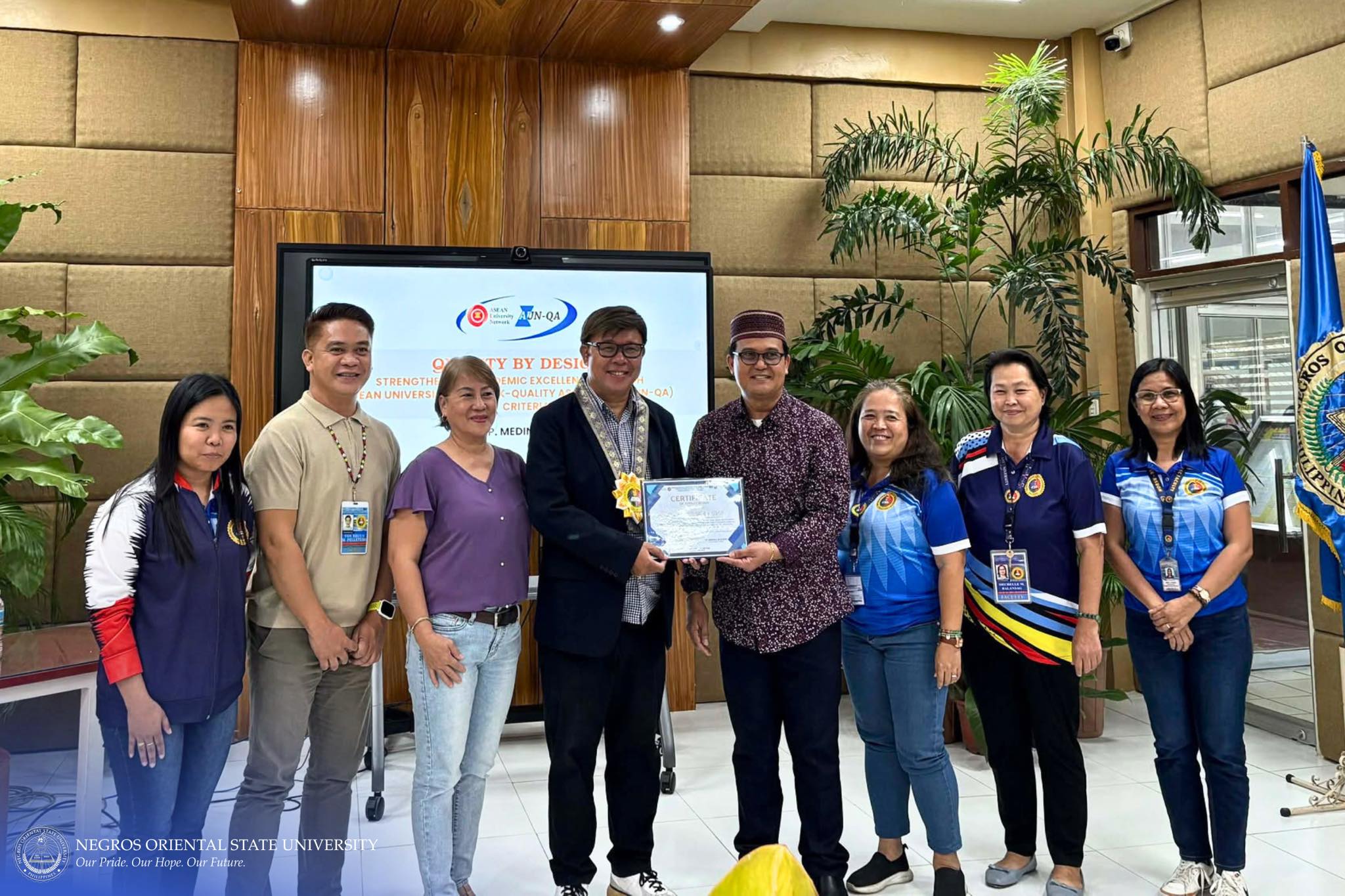







What if a single line in a syllabus could determine whether a graduate is truly ready for the world? This question took center stage as Negros Oriental State University (NORSU) convened academic leaders across campuses on March 25, 2026, for a one-day seminar-workshop aimed at rethinking how learning outcomes are written, aligned, and lived in the classroom. Held from 8:00 AM to 5:00 PM at the University Library, Main Campus, the seminar-workshop titled “Bridging CHED OBE and AUN-QA: Syllabi Enhancement through Criteria 1 and 2” gathered program chairpersons and curriculum and instruction chairs in a shared mission: to ensure that what is promised in the syllabus is exactly what is delivered in teaching and learning. At the heart of the discussion was the idea that outcomes are not mere statements - they are commitments. Leading the conversation was Engr. Ruji P. Medina, PhD, a respected authority in quality assurance and curriculum development. Currently serving as Director for Strategic Planning, Engagement, Accreditation, and Rankings (SPEAR) at Siquijor State College and holding the rank of Associate Professor V, Dr. Medina brought with him a wealth of experience shaped by his previous role as Dean of Graduate Programs at the Technological Institute of the Philippines–Quezon City. As a CHED National Technical Panel member with international certification in AUN-QA program assessment and self-assessment report writing, his expertise resonated strongly with participants. In his sessions, Dr. Medina unpacked two critical AUN-QA pillars: Criterion 1 - Expected Learning Outcomes and Criterion 2 - Program Structure and Content. He emphasized that clearly formulated outcomes should not exist in isolation but must be tightly aligned with curriculum design, teaching-learning activities, and assessment strategies. “If outcomes are unclear, everything that follows becomes misaligned,” he noted, challenging participants to rethink the precision and purpose of their syllabi. Due to time constraints, the workshop shifted from planned hands-on engagement to an active Question and Answer format designed to draw out participants’ ideas. Program chairpersons were encouraged to revisit and reflect on their faculty course outcomes, examine their alignment with program goals, and consider refinements using both CHED’s outcomes-based education (OBE) framework and AUN-QA standards. Through guided questioning and collaborative exchanges, participants critically explored how intended learning outcomes can be effectively translated into meaningful classroom practices. Dr. Medina also drew from his international exposure, sharing insights from academic engagements in Italy, Greece, Thailand, and the Philippines. His experiences in global quality assurance contexts provided participants with a broader perspective on how Philippine higher education institutions can position themselves within international benchmarks. The initiative was spearheaded by the Office of Curriculum and Instruction under the leadership of its Director, Dr. Ralph A. Cardeño, and conducted under the direct supervision of the Office of the Vice President for Academic Affairs. The seminar-workshop reflects NORSU’s sustained efforts toward curriculum harmonization, quality assurance strengthening, and alignment with both national policies and international accreditation frameworks. University officials expressed strong support for the initiative. Among those acknowledged were University President Hon. Noel Marjon E. Yasi, PsyD; Vice President for Academic Affairs Dr. Libertine C. De Guzman; Vice President for Student Affairs and Services and QUAMC Director Dr. Cesar P. Estrope; Vice President for Administration and Finance Dr. Merivic G. Catada; and Campus Director Dr. Ryan O. Tayco. Their leadership underscored the institution’s commitment to academic excellence and global competitiveness. Gratitude was likewise extended to Siquijor State College President Hon. Steven J. Sumaylo for allowing Dr. Medina to share his expertise with the NORSU community. His participation was seen as a valuable contribution to strengthening institutional linkages and knowledge exchange. The program was effectively facilitated by Prof. Carlo “Scarlet” M. Gadingan, who served as emcee and moderator, ensuring smooth transitions throughout the day’s sessions. Behind the scenes, the successful execution of the activity was made possible through the dedicated efforts of the Office of Curriculum and Instruction staff, particularly Ms. Sharlene Mae V. Magallanes and Mr. Rodiel U. Cayetano. The organizers also extend their appreciation for the invaluable support of Dr. Colette O. Abequibel, University Librarian, Mr. Noriel Garlito, IT Specialist, and the sound system personnel, whose technical and logistical assistance contributed significantly to the smooth conduct of the seminar-workshop. Participants described the workshop as both timely and transformative. Many noted that the activity clarified not only the technical aspects of writing outcomes but also the deeper responsibility of educators in shaping learner competencies. The collaborative environment encouraged the sharing of best practices, reinforcing a culture of continuous improvement across campuses. As the seminar concluded, one message remained clear: in an outcomes-based and globally connected educational landscape, the strength of a university begins with the clarity of its intentions - and how faithfully these are carried through in every syllabus, every lesson, and every graduate it produces.